Showing posts with label CCDB. Show all posts

Wednesday, July 14, 2010

Progressive Bikes UK CCDB Promotion

Check it out on Bike Rumor! Our UK Distributor, Progressive Bikes has a great write up on Bike Rumor, with a good explanation of how the frame and shock works together; along with a nice promotional package!


http://www.bikerumor.com/2010/07/13/chumba-racing-uk-cane-creek-double-barrel-promotion/

Saturday, May 15, 2010

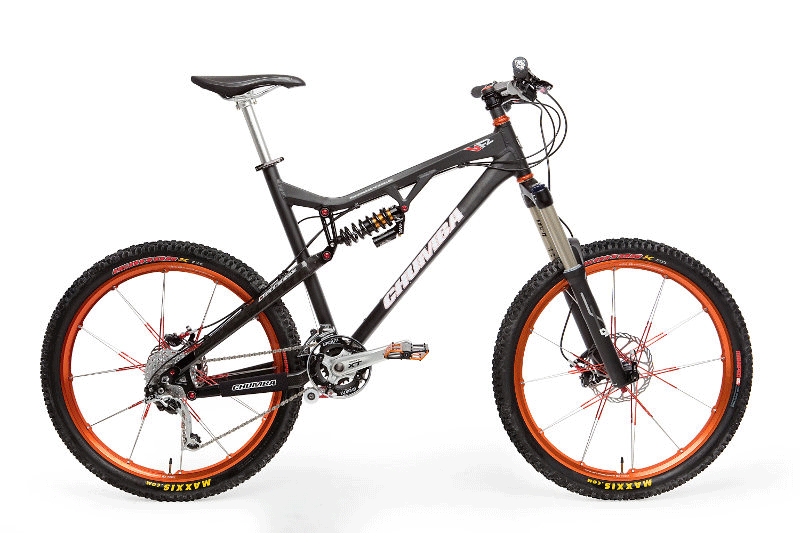
Nathan's VF2 Review and Picture

Hi Alan,
I was finally able to get some serious trail time in this past weekend so I thought I would give you my impression of the VF2.  My VF2 weighs in at 31.8lbs but it climbed like a 23 pound cross country racer.  It went down the hills like it has 2 more inches of travel then it does.  This bike just blew me away.  It took everything I threw at it and it was like it was saying "that's all you got." 
The CCDB is in a league of its own.  I am coming off of a Pushed RP23 and that shock does not even compare to the CCDB.  It is so nice not having to flip a pro-pedal switch all the time.  No it is just point and go and no worry's about whats in my way. 
Thanks so much to you and Jason for all of your help with this project.  I am a Chumba rider for life!!!  Keep me in the loop with what is happening with the new EVO and the longer travel XCL.
Thank you-
Nate  


Monday, January 18, 2010

Coil or Air?

Some people swear by air shocks - others by coil.  Sure, there are obvious benefits to air shocks, such as generally being lightweight, and less expensive than a coil with titanium spring.  However, the way these shocks work with different suspension linkages also influence people's decisions.  Since air shocks increase dampening exponentially as a shock compresses, frame designers often use a regressive leverage rate towards bottom-out to create the desired "linear" feel.  This is why some frames like the Ibis HD, which uses the DW Link, instruct riders to only use air shocks with their frames.  If a coil shock was used on this bike the suspension would end up feeling softer as you compress the linkage past the sag point towards full compression - essentially providing little bottom-out resistance.

On the other hand, many 4 bar frames have linear linkage feels, this gives the option to either run a coil shock or an air shock.  A coil shock - which is inherently linear coupled with a linear linkage - will give a feeling of controlled and predictable travel.  This is largely because the suspension would compress with an equivalent amount of force throughout its travel.  Conversely, if you ran a progressive air shock on this type of linkage, you would get a progressive feeling suspension.  So you have the option to run either coil or air with a linkage like the CHUMBA VF2 or XCL.

It's conceivable that some riders have used coil shocks on frames not designed to accept the linear rates of these dampers.  It's important to always double check with manufacturers first before swapping out different shocks to make sure that the results of the damper change will coincide with the desired ride feel.

You can shoot any suspension set up or tuning questions to tech@chumbaracing.com. Just to be clear though, all of CHUMBA frames were designed to accept either coil or air shocks, and we encourage the use of coil shocks.

Happy trails.

Tuesday, January 12, 2010

Tuesday, January 5, 2010

CHUMBA Racing - Cane Creek Double Barrel Shock Tuning Program

This whole project started because customers asked if the VF2 was capable of being more than just an XC bike and if they could improve upon the RP23 that was fitted to the VF2. Awhile back, Ted Tanouye, head of R&D at CHUMBA, and I were riding the Fullerton Loop in California. After climbing a steep section of the trail, we stopped, and I asked, “How is that rear shock?” Ted said “the VF2 with a CCDB could outperform an EVO equipped with an air shock.” For Ted - a man who developed championship-winning race bikes out of his garage – to make such a claim, gave cause for serious attention to this rear shock and how it would interact with CHUMBA frames, specifically, our VF2 linkage system.


So I turned to one of the industry’s most knowledgeable shock gurus – Josh Coaplan, head of R&D at Cane Creek. Josh helped develop the Double Barrel alongside other engineers at Ohlin’s Racing, the premier shock manufacturer for off-road equipment, like ATVs, snowmobiles, etc.

I sent Josh a VF2 frame for analysis of axle path and leverage ratio to help us optimize the complex settings of the CCDB for the VF2. From my conversations with Josh and Malcolm at Cane Creek - we hoped that this shock properly tuned to the VF2’s linkage would provide the basis in which to help reduce pedal-induced bob while retaining the superior bump absorption and traction that the CCDB is famed for. Coupled with the VF2’s linear linkage (more on that later) the CCDB would offer unrivaled shock tune-ability and performance.


Upon receipt of the frame, Cane Creek proceeded to build their own hardware to make sure a proper fit of the Double Barrel in the shock mount locations of the VF2. After Cane Creek received the VF2, they proceeded to equip it with the proper hardware, and started to do a full analysis of the leverage ratio, axle path, and other relevant data all from real-world data acquisition.


The data Cane Creek acquired, matched all of the R&D testing that we had confirmed in our 3-d modeling, as well are our prototypes, and actual production models.


CHUMBA’s frames have the unique advantage of allowing the suspension to behave the same way at all points of travel, allowing for smooth technical climbing, pedaling through rock gardens with a fully active suspension, and descending with complete confidence and predictability, whether riding on the trail, or hitting bigger drops and jumps.


CHUMBA and Cane Creek jointly analyzed shock settings and performance by testing the CCDB on the VF2 with professional riders, engineers, and test riders both at CHUMBA and Cane Creek. We then confirmed data between each other and found similar results.  Here's a pic of Cane Creek's VF2:


Given the linear nature of the VF2’s leverage ratio curve relative to other bikes in its class (although technically it is regressive and slightly progressive towards bottom out), the linkage will reflect a shock’s tuning very closely. This means, if you tune up the low speed compression, you will immediately feel this throughout the VF2 linkage’s travel without varying leverage rates from the linkage interfering with what you want the shock to do.

This means if you own a VF2, or are interested in one, you have the advantage to really custom tailor your Double Barrel to how you want it to perform at low speeds or high speeds, and the linkage will remain neutral to accept your change, making the combination of the VF2 and the Double Barrel one of the most customizable rides on the market.
Monday, January 4, 2010

CHUMBA Tech Article - Leverage Rates


There have been many exciting developments with CHUMBA over the last few months. But, before I get into that, I would first like to thank all of our loyal supporters and riders, and let everyone know that CHUMBA is truly on its way to becoming one of the world’s most prestigious bicycle brands. CHUMBA is focused on quickly developing and tuning our suspension technology, along with offering aesthetic and performance options unmatched by any other high-end company. Here are a few of the things we’ve been doing:
1. Identifying Suspension Curves and Accompanying Shock Settings to Maximize Performance
To make things easy – just remember that a decreasing leverage ratio means compression resistance is increasing; and increasing leverage ratio means compression resistance is decreasing. Just remember the analogy of a lever – imagine that you are trying to compress the shock with a lever. The longer the lever is the easier it will be to compress the shock; so the more you increase your leverage ratio, the easier it becomes to compress a shock. As your leverage ratio decreases, it will become harder to compress the shock.
As you can see in the chart above published by Trek’s R&D team, the leverage ratios at a given area in shock travel vary tremendously for some manufacturers. As you can see on the DW-Link Mojo – the dramatically varying and increasing leverage ratio towards the end of stroke means less bottom out resistance from the linkage. Additionally, the Santa Cruz Blur probably has one of the largest varying suspension rates, going from as high as 2.7 all the way down to 1.65. Further, on the DW Link and VPP, the leverage rates increase and decrease all throughout the curve – making for varying feels throughout the travel.
As you can see with the VF2 – the leverage ratio is predictably constant – making the travel feel extremely consistent and predictable when compared with the competition. You can see the variance of the compression resistance is minimal, being slightly regressive with a small amount of bottom out progressiveness at the end. Yamaha MX and CHUMBA test rider Dustin Nelson put it well when he says “linear rates give you the most amount of controlled feel over travel” – as you don’t need to compensate suspension feel with a varying leverage rate to try and make up for pedaling input from
the suspension.